Friday, January 1, 2016

Did You Know I Wrote A Book?

Did I ever tell you that I wrote a book?

Yes, me, the antithesis of all things literary.  Catch your breath.  

On this day, one year ago, I asked my best friend if she would consider spending the rest of her life with me.  Many of you know the story, at least the synopsis, but many of you don't.  So on this day, the one-year anniversary, I thought I'd share a little behind the scenes reflection.

Sarah has a love for books, more specifically a love for good stories.  She also loves love.  And if both literature and love can be intertwined, then we have a recipe for a happy Sarah.  I knew this about her and it was my plan all along to propose through paragraphs of well-articulated and meaningful love.

Months before I planned to propose, Sarah and I had a conversation about engagement.  She talked briefly about the necessary details for a meaningful proposal until I cut her off and said, "I know how I'd propose to you."   I won't tell you how early in our relationship the proposal conversation happened, but here's the proof:


At another point in our relationship, after Sarah recommended I read an incredibly sad book, we had this conversation:


We went on to joke about what the chapter titles for our hypothetical short story.  So, it seemed obvious to me how I should propose: write a book.  

For two months prior to the engagement I spent many (late) hours writing the chapters of our relationship.  That book led me to the most confident and anxiety-filled moment of my life.  As certain as I was that she would say 'yes,' I was equally terrified that the moment would fall flat.   
Alas, she said 'yes,' and I am so incredibly blessed that she did!  

So, to celebrate the anniversary of our engagement, I am offering the prologue to my our book, It's a Love Story.


            There are few things in life worth waking up and actually getting out of bed for.  Of course I don’t mean the unavoidable things like a full bladder, fire drill, tornado siren, gunshot, antsy dog, or nightmare.  I mean the few things in life that warm my heart more than any down, duvet, or Egyptian cotton ever could.  I mean the things that cause my heart to skip.  The things that give me reason to start a new day.  The things that give my life, my soul, even my love a purpose and meaning.  The things that render me speechless–not because I’m at a loss for words–but because in that moment there is no medium well equipped enough to help me express how I feel. 
            This is a story not only about those things but about the moments too.  It is about the moments that leave me breathless and speechless.  It is about the moments that say everything and nothing all at the same time.  It is about the moments—the good and the bad—that bring two people closer than any analogy ever can.  This is a story about the moments: the moment I met her, the moment I said hello, the moment my eyes got lost in hers, the moment our fingers interlocked for the first time, the moment she took my breath away, the moment I couldn’t shut up, the moment on the porch, in the car, with families, in the theater—in the moment.  The moment I knew. We knew.  The moments we are yet to have.
            If I had even the slightest glimpse of what these moments could feel like prior to that warm August day in 2013, I would have met her sooner.  Some way, some how, I would’ve chased her down.  They, whoever they is, always say, “When you know, you know,’ and I knew.  We knew.  And on that warm August day, in that moment I met her, that moment which gave me a reason to crawl out of bed, every possible ‘moment’ experience in my life up until that point faded away.  And I knew. We knew.  We were going to share in the moments.
            This is our story.


Sunday, December 27, 2015

Advent 2015 | Prepare the Way of the Lord


ADVENT 2015
One of my many roles at Bangsar Lutheran Church 
this year was to plan the theme and preaching series for Advent 2015.  Below is the outline of texts and themes, as well as a description of each week's theme.  I chose the theme: Prepare The Way of The Lord.  As part of my preparations for Advent I created 4 banners to be hung in connection with each week's theme.   

OVERVIEW:
As Christians we live in a time of now and not yet.  Living as witnesses of the resurrection, we eagerly await the second coming of Christ by living a life worthy of the Gospel message.  However, we often find ourselves impatient and exhausted by the call to share the good news of Christ.  Advent, the first season of the Christian church year, is a season full of anticipation and preparation.  Advent helps us align our impatience, not with each other or the stumbling blocks of God's mission, but with the long awaited Messiah, both now and not yet.  This Advent we will talk about 'Preparing the Way of the Lord' within our community and our own lives by remembering the age-old story of God's love and giving praise and thanks to God for God's fulfilled promises.  


WEEK-BY-WEEK:
Advent 1 | In community
      Jeremiah 33:14-16  |  1 Thessalonians 3:9-13  |  Luke 21:25-36
Since the birth of Christ, communities have formed around the Gospel message.  Some communities form for the purpose of persecuting Christ and Christians.  Some communities form as disciples, followers, early churches, and converts.  Again and again God shows us through history that the Gospel message is one that tears down walls and unites community.  We are united not as a community of small distinctive groups, but as a community of individuals – forming the body of Christ.  The message of the promised Messiah was and is meant for all people, and although there weren’t many people present that first Christmas day God intended for all people to hear the Good News, from wise men in the East to shepherds of the fields.  As we ‘Prepare the Way of the Lord’ this Advent, we do so in community, knowing that we are stronger together (as we are meant to be) than we are apart.  Together we wait in hope and faith for the promised Messiah and the long-awaited return of our Lord Jesus Christ.

Advent 2 | Remembering the old, old story
       Festival of the 9 Lessons and Carols  |  Luke 3:1-6
The death and resurrection of Christ is intricately connected to the birth of the promised Messiah.  It is because we know the outcome of Jesus’ life and ministry that we are able to understand the significance of his birth; therefore, we observe, remember, and celebrate the birth of Christ through the lens of the cross.  As Christians we acknowledge that the birth of the promised Messiah and redemption of God’s people through death and resurrection is not the first of God’s salvific work, but a continuation of God’s promise.  Scripture invites us into the history of God’s redeeming work then, now, and always.  As we ‘Prepare the Way of the Lord” this Advent, we do so by remembering the old, old story of God’s love, grace, mercy, forgiveness, and promise.  Together we join the whole hosts of heaven and the company of the saints proclaiming what God has done through history, is doing through the promised Messiah, and will continue to do in the final days.

Advent 3 | In our heart, soul, & mind
       Micah 5:1-5  | Hebrews 10:5-10  |  Luke 3:7-16       
In antiquity, God’s people longed for a Messiah to bring about the kingdom of God.  The prophets repeatedly spoke of a Messiah who would reign as king of kings, wonderful counselor, and prince of peace.  People were desperate for this Lord.  In the birth of Jesus Christ, the prophecies were fulfilled and the Kingdom of God has come near.  However, 2000 years later we remain desperate for the Messiah.  We are in continuous need of God’s redemption and salvation, gifted through grace.  We are a broken people longing for our Messiah.  As we ‘Prepare the Way of the Lord’ this Advent, we do so by preparing our heart, soul, & mind for the way of the Lord, realigning our desires, fears, hopes, and our very selves with the way of the Lord.  Together we hear the voice in the wilderness crying, ‘repent, and make straight the paths of the Lord’ because one who is more powerful is coming, and he will baptize us with the Holy Spirit and make us a new creation.

Advent 4 | Giving praise
     Zephaniah 3:14-20  |  Philippians 4:4-13  |  Luke 1:39-56

After receiving word that she is pregnant with the Son of God Mary sings praise to God.  She proclaims, “My soul glorifies the Lord and my spirit rejoices in God my savior.”  Mary’s delight is in God and God’s faithfulness as she recounts God’s steadfast mercy from generation to generation.  Her song is known as the ‘magnificat’.  In the season of Advent, as we anticipate the long expected Messiah, we are invited into Mary’s song of praise.  We rejoice in God’s steadfast mercy and faithfulness.  As we ‘Prepare the Way of the Lord’ this Advent, we do so by praising God for God’s faithfulness through the generations.  Together we lift our hearts to the Lord because the “Mighty One has done great things for” us and will continue to do great things.

Tuesday, December 1, 2015

Naming Homesickness

Sto·ic
ˈstōik/
noun
noun: stoic; plural noun: stoics
        
      1.  a person who can endure pain or hardship without 
      showing their feelings or complaining.
I'm stoic.  I know it.
My family probably knows it.
My CPE supervisor certainly knows it (she regularly told me so).
In the fullest definition of the word, I am stoic.  And that's ok.

But it's because of my incredible stoicism that I have a hard time admitting it.
(pause for a deep breath and an induced suspense-filled anticipatory moment)

I am homesick.  (Take that stoicism)

It's true. I do miss home. And because I hesitate to admit it out loud to anyone who asks, I confide in the secrecy of my online diary journal blog.  Let me be clear up front, Malaysia (the people, culture, friends, housing, weather, etc.) is not to be blamed for me feeling homesick.

When I was a kid (sometime during elementary school), I had a good friend named Justin.  One weekend I was invited to Justin's house for a sleep over.  To my recollection, it was my first sleep-over at a house that wasn't mine or a family member's.  I was excited, I think.  I remember playing Ninja Turtles in the basement, both action figure and nintendo.  Cowabunga!  I vaguely remember having a snack of some sort and perhaps pizza for dinner.  I remember it was time to go to bed.  Twenty-years-ago-Daniel thinks he laid in bed for hours before admitting he was homesick and wanting to go home, but present-day-Daniel knows it was most likely less than 10 minutes.

It wasn't Justin's fault.  It wasn't his parents' fault.  It wasn't the bed, pillow, or lighting.  It had nothing to do with their house at all.

In my own, uneducated, opinion I think my homesickness was fueled by the absence of 'normals' - routines.  It was the first time being away from everything comfortable, and there is nothing stronger than the silence of a pillow in a strange place to remind you that you're away from your 'normal.'

It wasn't my bed or my pillow.  It wasn't my room or my house.  It wasn't my parents down the hall.  It wasn't my bathroom sink I brushed my teeth in and it wasn't my 'normal'.  I missed the familiar, the routine.

The majority of my conversations thus far with people in Malaysia consist of weather and food, but for the first time a parishioner asked me if I was missing home and if that was hard.  Stoic-Daniel paused and started to shake his head no.  But honest-and-relieved-Daniel interrupted and said, "Yes, actually I am missing home.  Thank you for asking."

He doesn't know it, but it was the exact question I needed him to ask. It was such a relief to be able to say, "Yes, I am missing home" and not feel vulnerable or weak.  Stoic-Daniel would rarely tell someone I barely knew the truth in how I'm feeling, but in that moment it was comforting to know that someone cared enough to create a safe space for me to be honest.

Listen, Malaysia is incredible.  The people are awesome.  Our parishioners are genuine and passionate and caring.  Our housing is more than we could have asked for or expected.  There is food everywhere. Always.  And best of all, I'm with my wife (24/7).  But I can't deny that I, at times, feel homesick, especially this time of year.  And that is no one's fault.

A colleague reminded us this week that the typical period of time for culture shock to set in is 3-4 months.  Well, conveniently for us, 3-4 months coincides with the holidays.

I am missing the normal.  I miss my bed and my pillow.  I miss my family and my dog.  I miss my friends and my things.  I miss the traditions of thanksgiving meals and Christmas gatherings.  I miss getting a tree from the mountains on the Friday after Thanksgiving.   I miss the normalcies and routines of the holidays that I've known for 28 years.  It's no one's fault, and it's ok that I miss them.

I'm not seeking comfort or words of encouragement.  I'm not seeking gifts or packages or things from home.  I'm not (honestly) even writing this for you.  I'm doing this for me.  Naming my feelings (Yes, CPE feeling wheel, I know homesickness is not a feeling).

Home·sick
/'hōm,sik/
adjective
        
      1.  experiencing a longing for one's home during a period of absence from it.

I may be a stoic (and a good one at that), but I am a homesick stoic.  It's no one's fault.  I am simply naming it in the secrecy of my online diary journal blog for myself.

"Miss you too, dad!"

Sunday, October 18, 2015

Sticks and Bricks

“It’s just sticks and bricks.”

Two weeks after moving into our newly constructed dream home, my mom stood in the kitchen with my dad and said, “It’s just sticks and bricks.”

My mom's dream home complete with widows peak, veranda, & porch swing.
For the longest time my mom dreamed about, planned, and designed her dream home.  She spent hours tearing out the pages of magazines, driving through fancy neighborhoods, and searching local open house flyers.  She dreamt of a large two story Victorian house perched on a hill.  She wanted a widows peak roof.  She was adamant about a wrap around porch with a swing.  She wanted the large foyer entryway.  She was passionate about the dream home.

It took almost three years, but from her dreams came a reality.  The house was built—wrap around porch and all.  It was perched on the hill of two lots, and its witch’s hat roof pointed high into the sky.  I remember seeing the smile on mom’s face when we finally moved in.

“It’s just sticks and bricks,” Dad recalled as we stood in the foyer of my mom’s dream home, saying our final goodbye in April 2015.  I won’t lie, it was sad.  But then Dad reminded all of us that the love of our family is not confined to the walls of Mom’s dream home.  In fact, my mom’s dreams are not limited to those sticks and bricks, as pretty as they are.  Dad reminded us that home for him now is where my brother, his wife, and their son are.  Home is where Sarah and I are (even in Malaysia).  Home is where he, his wife, and my new sisters are.  “Home,” Dad said, “is where Mom’s love and Mom’s dreams are being carried out.”  Home is about the people who share in love in that place.

I guess my point is this: There are a lot of homes in our lives.  There are lots of buildings in which we dwell.  But no matter how pretty or how big those buildings are, no matter how sturdy or expensive they get, their walls cannot form us into who we are.  Yes, growth and formation take place within the walls, but it is the love that people share in that place that fuels the formation.

I think we too often get stuck wanting bigger or better places.  We get lost repairing, replacing, or rebuilding the places in which we dwell.  We focus on a bigger this, or a fancier that.  We get lost in the sticks and bricks of our lives.

One of my favorite hymns, All Are Welcome, says this: “Let us build a house where love can dwell and all can safely live, a place where saints and children tell how hearts learn to forgive.  Built of hopes and dreams and visions, rock of faith and vault of grace; here the love of Christ shall end divisions: All are welcome in this place.”

I will never forget the sticks and bricks at 406 4th Avenue that my mom dreamed up, but even more so I will never forget the formidable years I spent growing up there in love.  And as homes come and go, I am truly blessed and thankful for the many places I've had the chance to call home - where love truly dwells. 

This post is an excerpt from my article in the monthly St. Paul's Cross Connections Newsletter in April 2015.

Saturday, September 26, 2015

The Day-To-Day

The street sign of our home.
We're adjusting well to (married) life!  More specifically, we're adjusting well to married life in Malaysia.  Certainly there were many adjustments we had to make during our first few weeks, but as we celebrate our  one-month anniversary (marriage and residency) we're adjusting well.  Thankfully, through technology we're able to share pieces of our life in Malaysia through Facebook and FaceTime.  However, we've gotten a lot of questions about the adjustments we've made, and what our day-to-day lives look like. So, here is an inside look at several of our day-to-day adjustments.

Water 
Routinely UV filtering water and filling our bottles.
It was recommended to us that we don't drink the tap water in Malaysia, at least not for the first few months.  So, this means we have to use an abundance of water bottles.  Please don't worry, we hate wasting plastic bottles as much as the next person, and thanks to some awesome people, we're able to refill our plastic water bottles.  Shout out to our Aunt Pam & Uncle Steve, as well as Garrison, Amy, and Emory Locke!  For our wedding, they gifted us two sweet UV filter camel back water bottles.  So, everyday we run tap water (which is double filtered from the sink) into our fancy camel back UV bottles, shake them for 60 seconds under the UV light, then refill our plastic water bottles.  Due to the heat, the haze, and our new 1/2 marathon training program, Sarah and I drink about 8-10 bottles a day each.  I'll let you do that math.  Thanks Garrison, Amy, Emory, Steve, and Pam!

Transportation
The way we commute from point A to point B was drastically different one month ago.  Although we have our international permits, we don't have the luxury of a car while we are in Malaysia.  Therefore, we have to rely on either other people fetching (British influence) us or start walking and then take the LRT (Light Rail Transit).  Walking is our new favorite hobby.  We average anywhere from 3-5 miles of walking daily.  This is on top of the 3-5 miles we run at the gym 4 times a week.


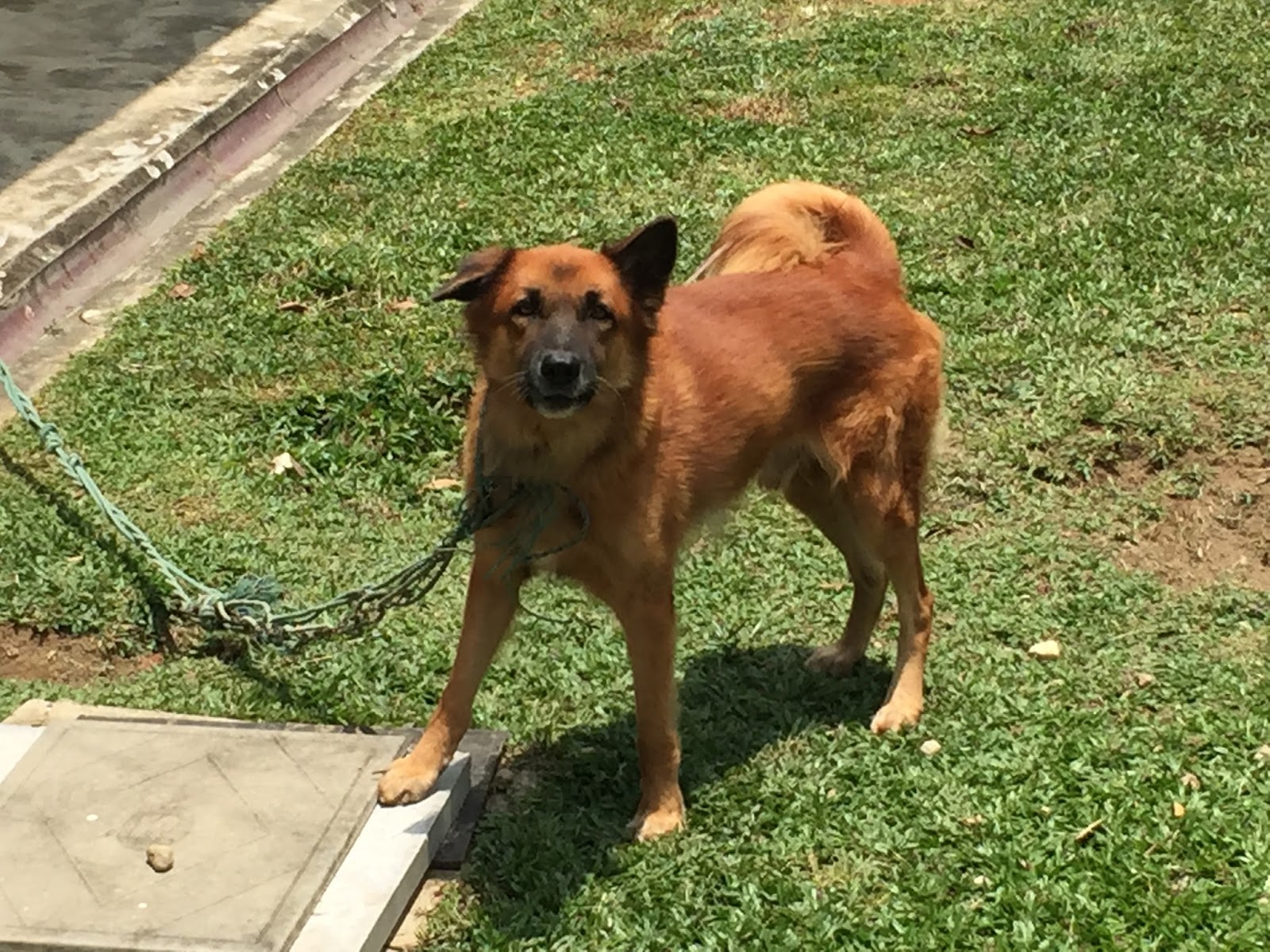
In order to journey out into the big city, we first lock up our Bungalow.  There are 4 locks between our bedroom and the street.  Next, we greet our guard-dog, Buddy.  He is ferocious, but slowly warming up to us (I think).  Some days are friendlier than others. 


Laundry
We are very fortunate to have a washing machine in our house, but what we don't have (and don't need) is a dryer.  So, when we wash our clothes we hang them out to dry.  I know this is not a revolutionary concept or huge inconvenience, but it is something new to us.


Food! And it's cheap!
Because of the exchange rate, Sarah and I are financially blessed here with regards to food.  So, we eat.  And we eat a lot.  We've gotten a lot of questions about how much things cost here, so let me give you a few examples of our favorite meals.

Roti Canai
Left: This is roti.  It is a flat fried bread similar to a crepe.  You can get roti made with bananas, egg, margarine, sugar, and a variety of other fillings.  It is served with a curry sauce for dipping.  Sarah often gets 2 plain roti and I get a roti pisang gula (roti with banana and sugar).  We also get two coffees. One plain roti = 1 ringgit.  Our total breakfast is about 8 ringgits, which is ~$2 USD.

 
Subway Meal = ~$3.00
There are a variety of traditional western restaurants such as Chili's, Texas (Church's) Chicken, Subway, KFC, Burger King, and McDonald's.  We often order Chili's for delivery as a feel good meal when we miss home, and  when we run 4 miles.  Another favorite of ours is Texas Chicken.  We're able to get a taste of home (including sweat tea) for only ~$7 USD.

Traditional dim sum


We've also been very blessed to have wonderful new friends and parishioners take us to try a variety of foods.
The culture is centered on sharing meals together.  Sarah and I have yet to meet anyone new from the church without food on the table.
We've had Cantonese food, which was a bed of rice (a theme you will see frequently) with various dishes - cabbage, bean curd, and chicken. It was all very good.
We were introduced to authentic Indian food - rice, lamb curry, roasted chicken with vegetables, and so many good Malaysian fruits.
We tried Thai food - garlic pepper chicken, pandan chicken, vegetables, and a really spicy soup (over rice).
All of these great foods not to mention a large variety of cakes, pastries, waffles, coffees, teas, and fruits.


Haze
Every year Indonesia peat bogs continue to burn.  The bogs are drained in order to make room for farming and under the right (dry) circumstances, peat will burn indefinitely. Some peat fires have been burning in Indonesia since 1997.  The problem with all the burning is that it creates a thick haze.  Some days it is worse than others and it will be around until rainy season begins in November.


You can read more about the peat fires and the settling haze on Sarah's blog: Hazed - and - Confused

Right: This is a picture of our walk to dowtown Petaling Jaya.  It was taken the first week we arrived.

Below: The same picture taken three weeks later when the hazed set it.  Visibility was under one mile.


These are just a few of the day-to-day aspects of our lives in Malaysia.  We would love to share more with you and invite you to message us with any other questions you have.  We miss you all!


Saturday, September 5, 2015

Adjusting to my New Normal

I never assumed that moving half way around the world for a year would be easy.  I don't consider myself to be naive, and I knew that there would be many challenges, adjustments, frustrations, and (of course) blessings.  Things that were comfortable and second-nature in the states may no longer be as comfortable (or natural) in our home-away from home.  And in these times of cultural adjustment, when I experience something drastically different than 'what I'm used to," we I tend to over use the phrase 'I take for granted...'

"I take for granted my comfortable life at home."  
"I take for granted my friends and family."  
"I take for granted my car and my simple ability to commute from point A to point B."  
"I take for granted my shower, bed, phone, etc.."   

It seems that each time I encounter something new that challenges my comfort zone, my knee-jerk reaction is to think of its home-equivalent, miss it, and then dwell in the fact that I take it for granted.  But after two weeks of culture shock, lifestyle adjustments, and warm hospitality, I must admit that my knee-jerk reaction is wrong.  It's simply wrong.  And not to mention, it's unfair.

If my first reaction to an unfamiliar situation is to lament that I take its home-equivalent for granted, then perhaps I am holding my own norm and context in a higher regard than the one I'm experiencing.  To say I take something for granted is to say that yours isn't good enough for me.  I know it communicates a posture of superiority, which belittles the contextual norm of my new surrounding, and I hate it.  I hate that my gut says, "this isn't as good (fun, tasty, difficult, troublesome, etc.) as home," thereby dismissing this.  By an unfair comparison, and a better-than-thou complex, I communicate that my culture is somehow better than yours.  I KNOW this is unfair, and for that I am sorry.

The last two weeks have been incredible.  Let's not mistake that fact.  But that isn't to say it hasn't been without its challenges.  It hasn't been without necessary cultural adjustments.  And it certainly hasn't been without lifestyle changes.

In my first two weeks here, I've come to realize that my knee-jerk reaction, which tends to unfairly hold your norm in comparison to mine, is wrong.  I apologize for that.  This realization has taught me that while cultural comparison is appropriate within the context of discussing our differing cultures and the ways in which we are influenced by them, it is not appropriate when it belittles or dismisses the culture I am experiencing.  It is not okay to hold another's culture below you own.

I think there is a drastic difference between saying, "I miss my way of life back home," and saying, "This way of life doesn't compare well to mine."  There is a clear distinction between the two.  I've held both of these statements in my mind on multiple occasions these past two weeks, and while I don't apologize for missing (at times) my comfortable way of life, I DO apologize for the times in which I have unfairly compared my normal way of life to yours.

So, from here on I promise to be intentional about how I think, talk, interpret, feel, and describe about new challenges - new normals.  And rather than determine how a certain experience differs from my own, I promise to intentional remember that this culture (though different than my own) is in no way, shape, or form insignificant.  After all, it is my new normal.

The Petronas Twin Towers in the Kuala Lumpur City Centre.  Photo by: Sarah Locke